基本变量
dfn[u]:搜索时间戳(DFS 序)low[u]:能回溯到的最早时间戳
low[u] 的更新:
- 初始化:
low[u] = dfn[u]
- 树边
u → v(u = fa(v)):回溯时更新,low[v] 已知
low[u] = min(low[u], low[v])
- 非树边
(u, v) ∉ dfs_tree:
low[u] = min(low[u], dfn[v])
以下内容注重算法和代码,基本概念定义请自行搜索了解。
割点
- 判定法则:
dfn[u] <= low[v],其中 v 为搜索树上 u 的子节点。特别地,u = root 时,需子节点 v1, v2 均满足。
- 证明:考虑包含
(u, v) 的环结构。若 u 为割点(环顶),则仅当 (x, v) 一定包含 (u, v),即外点 x 到达 v 必须晚于到 u,u 为必经关卡。
1
2
3
4
5
6
7
8
9
10
11
12
13
14
15
16
17
18
19
20
21
22
23
24
25
26
27
28
29
30
31
32
33
34
35
36
37
38
39
40
41
42
43
44
45
46
47
48
49
50
51
52
53
54
55
56
57
58
| #include<bits/stdc++.h>
using namespace std;
typedef long long ll;
const int N=1e5+5;
vector<int> g[N];
bool cv[N];
int n,m,dfn[N],low[N],cnt,i,ans;
void tarjan(int u)
{
low[u]=dfn[u]=++cnt;
int son=0;
for(int v:g[u])
{
if(!dfn[v])
{
tarjan(v);
low[u]=min(low[u],low[v]);
if(low[v]>=dfn[u])
{
son++;
if(u!=i||son>1) cv[u]=1;
}
}
else low[u]=min(low[u],dfn[v]);
}
}
int main()
{
ios::sync_with_stdio(0);
cin.tie(0);
cout.tie(0);
cin>>n>>m;
while(m--)
{
int x,y;
cin>>x>>y;
g[x].push_back({y});
g[y].push_back({x});
}
for(i=1;i<=n;i++)
{
if(!dfn[i]) tarjan(i);
}
for(int i=1;i<=n;i++)
{
if(cv[i]) ans++;
}
cout<<ans<<'\n';
for(int i=1;i<=n;i++)
{
if(cv[i]) cout<<i<<' ';
}
return 0;
}
|
割边
P1656 炸铁路
- 判定法则:
dfn[u] < low[v],其中 v 为搜索树上 u 的子节点(不能取等,否则如果有重边则割边之后仍连通)。
- 虽然是按点深搜,但其实是在遍历边。故不能走反边。
- 如何标记反边?
- 序号标记,使正反边的序号满足成对一一映射。用
x ^ 1 = y。则 (x, y) 为相邻的奇数和偶数,例如 (2, 3):2 ^ 1 = 3,3 ^ 1 = 2。
- 标记父节点(无法处理重边)。
1
2
3
4
5
6
7
8
9
10
11
12
13
14
15
16
17
18
19
20
21
22
23
24
25
26
27
28
29
30
31
32
33
34
35
36
37
38
39
40
41
42
43
44
45
46
47
48
49
50
51
52
53
54
55
56
57
58
59
| #include<bits/stdc++.h>
using namespace std;
typedef long long ll;
const int N=151,M=5*1e3+5;
struct Edge{
int a,b;
};
vector<Edge> e;
vector<int> g[N];
int tot,cnt,len;
int n,m,dfn[N],low[N];
Edge bridge[M];
bool cmp(Edge x,Edge y)
{
if(x.a==y.a) return x.b<y.b;
return x.a<y.a;
}
void tarjan(int u,int in_edge)
{
dfn[u]=low[u]=++tot;
for(int id:g[u])
{
int v=e[id].b;
if(!dfn[v])
{
tarjan(v,id);
low[u]=min(low[u],low[v]);
if(dfn[u]<low[v])
{
bridge[++len]={min(u,v),max(u,v)};
}
}
else if(id!=(in_edge^1)) low[u]=min(low[u],dfn[v]);
}
}
int main()
{
ios::sync_with_stdio(0);
cin.tie(0);
cout.tie(0);
cin>>n>>m;
for(int i=1;i<=m;i++)
{
int x,y;
cin>>x>>y;
e.push_back({y,x}),g[y].push_back(e.size()-1);
e.push_back({x,y}),g[x].push_back(e.size()-1);
}
tarjan(1,0);
sort(bridge+1,bridge+1+len,cmp);
for(int i=1;i<=len;i++)
{
cout<<bridge[i].a<<' '<<bridge[i].b<<'\n';
}
return 0;
}
|
强连通分量(SCC)
由 OI WIKI,
在有向图 $G$ 中,如果两个顶点间至少存在一条路径,称两个顶点强连通(strongly connected)。如果有向图 $G$ 的每两个顶点都强连通,称 $G$ 是一个强连通图。非强连通图有向图的极大强连通子图,称为强连通分量(strongly connected components)。
对于一个这样的 DFS 搜索树:
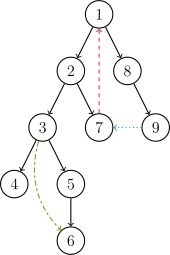
- 树边(tree edge):示意图中以黑色边表示,每次搜索找到一个还没有访问过的结点的时候就形成了一条树边。
- 反祖边(back edge):示意图中以红色边表示(即 $7 \rightarrow 1$),也被叫做回边,即指向祖先结点的边。
- 横叉边(cross edge):示意图中以蓝色边表示(即 $9 \rightarrow 7$),它主要是在搜索的时候遇到了一个已经访问过的结点,但是这个结点并不是当前结点的祖先。
- 前向边(forward edge):示意图中以绿色边表示(即 $3 \rightarrow 6$),它是在搜索的时候遇到子树中的结点的时候形成的。
反祖边(横叉边可能)$\to$ 环 $\to$ SCC。
所以对于一个 SCC,肯定含至少一个环,取环顶编号 $u$ 为特征值。(low[u] = dfn[u],因为环内最小编号,low 值不更新)
在搜索树上表现为:如果结点 $u$ 是某个强连通分量在搜索树中遇到的第一个结点,那么这个强连通分量的其余结点肯定是在搜索树中以 $u$ 为根的子树中。结点 $u$ 被称为这个强连通分量的根。比如上图 $1 \rightarrow 2 \rightarrow 7 \rightarrow 1$ 的根就是 $1$,且 low[1,2,7] = 1。
1
2
3
4
5
6
7
8
9
10
11
12
13
14
15
16
17
18
19
20
21
22
23
24
25
26
27
28
29
30
| vector<int> g[M];
stack<int> s;
int n,m,cnt,tot;
int scc[N],siz[N],dfn[N],low[N];
void tarjan(int u)
{
dfn[u]=low[u]=++tot;
s.push(u);
for(int v:g[u])
{
if(!dfn[v])
{
tarjan(v);
low[u]=min(low[u],low[v]);
}
else if(!scc[v]) low[u]=min(low[u],dfn[v]);
}
if(dfn[u]==low[u])
{
int x;cnt++;
do{
x=s.top();
s.pop();
scc[x]=cnt;
siz[cnt]++;
}while(x!=u);
}
}
|
SCC 缩点
其实就是 SCC 的应用。将每个 SCC 缩成点,原图就变成了 DAG,有关于出入度等特殊性质。
P3387 【模板】缩点
直接进行 DFS 的话,就会在环那里转圈耗时过长(因为可重复经过,不能用 vis 标记)。类似题有 DAG 的最长路径,一个做法利用其无后效性 DP。如何将该题的有环图 $\to$ 无环图?缩点。
1
2
3
4
5
6
7
8
9
10
11
12
13
14
15
16
17
18
19
20
21
22
23
24
25
26
27
28
29
30
31
32
33
34
35
36
37
38
39
40
41
42
43
44
45
46
47
48
49
50
51
52
53
54
55
56
57
58
59
60
61
62
63
64
65
66
67
68
| #include<bits/stdc++.h>
using namespace std;
typedef long long ll;
const int N=1e6+5,M=1e5+5;
vector<int> g[M];
vector<int> e[M];
stack<int> s;
int n,m,cnt,tot;
int dfn[N],low[N],w[N],dp[N],scc[N],a[N];
void tarjan(int x)
{
dfn[x]=low[x]=++tot;
s.push(x);
for(int y:g[x])
{
if(!dfn[y])
{
tarjan(y);
low[x]=min(low[y],low[x]);
}
else if(!scc[y]) low[x]=min(low[x],dfn[y]);
}
if(dfn[x]==low[x])
{
int y;cnt++;
do{
y=s.top();s.pop();
scc[y]=cnt;
w[cnt]+=a[y];
}while(y!=x);
}
}
int main()
{
ios::sync_with_stdio(0);
cin.tie(0);
cout.tie(0);
cin>>n>>m;
for(int i=1;i<=n;i++) cin>>a[i];
for(int i=1;i<=m;i++)
{
int x,y;
cin>>x>>y;
g[x].push_back({y});
}
for(int i=1;i<=n;i++)
{
if(!dfn[i]) tarjan(i);
}
for(int u=1;u<=n;u++)
{
for(int v:g[u])
{
if(scc[v]!=scc[u]) e[scc[u]].push_back({scc[v]});
}
}
for(int u=cnt;u>=1;u--)
{
if(!dp[u]) dp[u]=w[u];
for(int v:e[u])
dp[v]=max(dp[u]+w[v],dp[v]);
}
for(int u=1;u<=cnt;u++) dp[0]=max(dp[0],dp[u]);
cout<<dp[0];
return 0;
}
|
边双连通分量(eDCC)
边双连通图:不含割边的无向连通图。
边双连通分量:极大边双连通子图。极大 $:=$ 不存在完全包含该图(点和边)的边双连通子图。
定理
$$
\text{边双连通图} \iff \forall e,\ e \in \text{简单环(不自交的环)}
$$
证明:
- 充分性:$\forall x,y \in V$,$(x,y)$ 有 2 条。删除任意一条边,$(x,y) \ge 1$ 条,不符合割边定义。
- 必要性:不含割边,即 $\forall x,y \in V$,$(x,y)$ 至少有 2 条(否则路径上所有边都为割边),显然满足环的定义。
算法:类似 SCC。由定理,其实就是在无向图上求环。
P8436 【模板】边双连通分量
1
2
3
4
5
6
7
8
9
10
11
12
13
14
15
16
17
18
19
20
21
22
23
24
25
26
27
28
29
30
31
32
33
34
35
36
37
38
39
40
41
42
43
44
45
46
47
48
49
50
51
52
53
54
55
56
| #include<bits/stdc++.h>
using namespace std;
typedef long long ll;
const int N=5*1e5+5,M=2*1e6+5;
vector<pair<int,int> > e;
vector<int> g[N];
stack<int> s;
vector<int> edcc[N];
int n,m,tot,cnt,dfn[N],low[N];
void tarjan(int x,int in_edge)
{
dfn[x]=low[x]=++tot;
s.push(x);
for(int id:g[x])
{
int y=e[id].second;
if(!dfn[y])
{
tarjan(y,id);
low[x]=min(low[x],low[y]);
}
else if(id!=(in_edge^1)) low[x]=min(low[x],dfn[y]);
}
if(dfn[x]==low[x])
{
int y;cnt++;
do{
y=s.top();s.pop();
edcc[cnt].push_back(y);
}while(y!=x);
}
}
int main()
{
ios::sync_with_stdio(0);
cin.tie(0);
cout.tie(0);
cin>>n>>m;
for(int i=1;i<=m;i++)
{
int x,y;
cin>>x>>y;
e.push_back({y,x}),g[y].push_back(e.size()-1);
e.push_back({x,y}),g[x].push_back(e.size()-1);
}
for(int i=1;i<=n;i++)
if(!dfn[i]) tarjan(i,0);
cout<<cnt<<'\n';
for(int i=1;i<=cnt;i++)
{
cout<<edcc[i].size();
for(int u:edcc[i]) cout<<' '<<u;
cout<<'\n';
}
return 0;
}
|
eDCC 缩点
SCC 缩点,得到 DAG。
eDCC 缩点 $\to$ 树/森林(因为满足每两个点间存在唯一路径)。
利用树的性质构造答案。
P2860 [USACO06JAN] Redundant Paths G
路径问题,考虑边双缩点。由定理,eDCC 里的不用加边,只需考虑割边。
问题转化为:树 $\to$ 每个点 $\in$ 一个简单环 的最短加边数。
连接叶子节点,可以连接在它上面的所有点形成环,显然最优。
对树的叶子节点数分奇偶讨论,尽可能两两配对,画几个图找规律即可。
1
2
3
4
5
6
7
8
9
10
11
12
13
14
15
16
17
18
19
20
21
22
23
24
25
26
27
28
29
30
31
32
33
34
35
36
37
38
39
40
41
42
43
44
45
46
47
48
49
50
51
52
53
54
55
56
57
58
59
60
61
62
63
64
65
66
|
#include<bits/stdc++.h>
#define f(i,l,r) for(int i=l;i<=r;i++)
#define N 10000+5
using namespace std;
int n,m,cnt,num;
int ver[2*N],nxt[2*N],head[2*N],tot=1;
int dfn[N],low[N],deg[N],c[N];
bool bri[N];
stack<int> s;
void add(int x,int y)
{
ver[++tot]=y,nxt[tot]=head[x],head[x]=tot;
}
void tarjan(int x,int e)
{
dfn[x]=low[x]=++cnt;
s.push(x);
for(int i=head[x];i;i=nxt[i])
{
int y=ver[i];
if(!dfn[y])
{
tarjan(y,i);
low[x]=min(low[x],low[y]);
if(low[y]>dfn[x]) bri[i]=bri[i^1]=1;
}
else if(i!=(e^1)) low[x]=min(low[x],dfn[y]);
}
if(low[x]==dfn[x])
{
int y;++num;
do{
y=s.top();
s.pop();
c[y]=num;
}while(y!=x);
}
}
int main()
{
ios::sync_with_stdio(0);
cin.tie(0);
cin>>n>>m;
f(i,1,m)
{
int x,y;
cin>>x>>y;
add(x,y),add(y,x);
}
tarjan(1,0);
for(int i=2;i<=tot;i+=2)
if(bri[i]) deg[c[ver[i]]]++,deg[c[ver[i^1]]]++;
int sum=0;
f(i,1,num)
{
if(deg[i]==1) sum++;
}
cout<<(sum+1)/2;
return 0;
}
|
点双连通分量(vDCC)
类比边双定义:
- 点双连通图:不含割点的无向连通图。
- 点双连通分量(vDCC):极大点双连通子图。
Thm1 任意割点 $\in$ 至少 2 个 vDCC 中(裂点)
证明:去掉任意一个割点 $x$,图至少会分裂成两个连通子图。每个连通子图去掉自己的割点,直接与割点 $x$ 相连的部分显然可以合并成一个 vDCC。
Lemma 2 个 vDCC 至多 1 个公共点
证明:若 2 个,则 2 个点都可作为割点,可以合并成一个 vDCC。
Thm2 非割点最多只在一个点双连通分量内
证明:反设只有(Lemma)一个非割点 $x$ 在 2 个 vDCC 中。由于非割点,去掉 $x$ 后 2 个 vDCC 仍连通,可以合并。矛盾。
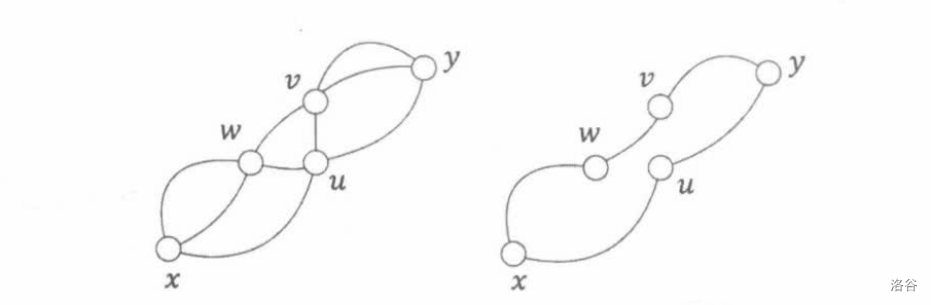
Thm3 一张无向图是点双连通图,当且仅当满足下列两个条件之一:
(1) 图的顶点数不超过 2;
(2) 图中任意两点都同时包含在至少一个简单环中。其中“简单环”指的是不自交的环,也就是我们通常画出的环。
证明:
(1)显然。
(2)充分性:有环就有两条路,使一条路上割掉点 $p$,两点仍以另一条连通。排除 $p$ 是割点。
必要性:反证法。
- 不是环?$(x,y)$ 要是一条路,路上都是割点。
- 自交?交点成割点。
关于根节点的入栈问题解释
关于出栈另一种写法的问题解释
算法:
- 进栈;
dfn[x] <= low[y],则 x 为割点/根节点。由 Thm1,找 y 为环顶的 vDCC(具体就是弹出节点,直至 y 被弹出)。
1
2
3
4
5
6
7
8
9
10
11
12
13
14
15
16
17
18
19
20
21
22
23
24
25
26
27
28
29
30
31
32
33
34
35
36
37
38
39
40
41
42
43
44
45
46
47
48
49
50
51
52
53
54
55
56
57
58
59
60
61
| #include<bits/stdc++.h>
using namespace std;
typedef long long ll;
const int N=5*1e5+5,M=2*1e6+5;
vector<int> g[N];
stack<int> s;
vector<int> vdcc[N];
int n,m,tot,cnt,root,cv[N],dfn[N],low[N];
void tarjan(int x)
{
dfn[x]=low[x]=++tot;
s.push(x);
if(!g[x].size())
{
vdcc[++cnt].push_back(x);
return;
}
for(int y:g[x])
{
if(!dfn[y])
{
tarjan(y);
low[x]=min(low[x],low[y]);
if(dfn[x]<=low[y])
{
int t;cnt++;
do{
t=s.top();s.pop();
vdcc[cnt].push_back(t);
}while(t!=y);
vdcc[cnt].push_back(x);
}
}
else low[x]=min(low[x],dfn[y]);
}
}
int main()
{
ios::sync_with_stdio(0);
cin.tie(0);
cout.tie(0);
cin>>n>>m;
while(m--)
{
int x,y;
cin>>x>>y;
if(x==y) continue;
g[x].push_back({y});
g[y].push_back({x});
}
for(root=1;root<=n;root++)
if(!dfn[root]) tarjan(root);
cout<<cnt<<'\n';
for(int i=1;i<=cnt;i++)
{
cout<<vdcc[i].size();
for(int u:vdcc[i]) cout<<' '<<u;
cout<<'\n';
}
return 0;
}
|
典例
P7687 [CEOI2005] Critical Network Lines
删掉该路图会不连通,所以为割边。筛出符合的即可。
1
2
3
4
5
6
7
8
9
10
11
12
13
14
15
16
17
18
19
20
21
22
23
24
25
26
27
28
29
30
31
32
33
34
35
36
37
38
39
40
41
42
43
44
45
46
47
48
49
50
51
52
53
54
55
56
57
58
59
60
61
62
63
64
| #include<bits/stdc++.h>
using namespace std;
typedef long long ll;
const int N=1e5+5,M=1e6+5;
vector<int> g[N];
vector<pair<int,int> > e;
int n,m,k,l,tot,cnt;
int low[N],dfn[N],cv[N],cnl[M],a[N],b[N];
void add(int x,int y)
{
e.push_back({x,y});
g[x].push_back(e.size()-1);
}
void tarjan(int x,int in_edge)
{
dfn[x]=low[x]=++tot;
for(int id:g[x])
{
int y=e[id].second;
if(!dfn[y])
{
tarjan(y,id);
low[x]=min(low[x],low[y]);
if(dfn[x]<low[y])
{
if(!a[y]||!b[y]||a[y]==k||b[y]==l) cnl[++cnt]=id;
}
a[x]+=a[y];b[x]+=b[y];
}
else if(id!=(in_edge^1)) low[x]=min(low[x],dfn[y]);
}
}
int main()
{
ios::sync_with_stdio(0);
cin.tie(0);
cout.tie(0);
cin>>n>>m>>k>>l;
for(int i=1;i<=k;i++)
{
int x;
cin>>x;
a[x]=1;
}
for(int i=1;i<=l;i++)
{
int x;
cin>>x;
b[x]=1;
}
for(int i=1;i<=m;i++)
{
int x,y;
cin>>x>>y;
add(x,y),add(y,x);
}
tarjan(1,0);
cout<<cnt<<'\n';
for(int i=1;i<=cnt;i++)
cout<<e[cnl[i]].first<<' '<<e[cnl[i]].second<<'\n';
return 0;
}
|
P2341 [USACO03FALL / HAOI2006] 受欢迎的牛 G
喜欢它等价于可达它。
任意一个 SCC 内点都是互相可达的,属于同一类点。真正的三角恋
考虑缩点,那么 Cow Star 显然就是新图唯一的叶子结点(出度为 0)。因为每个新点都可到达它。
不唯一则叶子结点间不互相可达。无 cow star。
1
2
3
4
5
6
7
8
9
10
11
12
13
14
15
16
17
18
19
20
21
22
23
24
25
26
27
28
29
30
31
32
33
34
35
36
37
38
39
40
41
42
43
44
45
46
47
48
49
50
51
52
53
54
55
56
57
58
59
60
61
62
63
64
65
66
67
68
69
| #include<bits/stdc++.h>
using namespace std;
typedef long long ll;
const int N=1e4+5;
vector<int> g[N];
vector<int> e[N];
stack<int> s;
int n,m,cnt,tot;
int dfn[N],low[N],scc[N],siz[N],deg[N];
void tarjan(int x)
{
dfn[x]=low[x]=++tot;
s.push(x);
for(int y:g[x])
{
if(!dfn[y])
{
tarjan(y);
low[x]=min(low[x],low[y]);
}
else if(!scc[y]) low[x]=min(low[x],dfn[y]);
}
if(low[x]==dfn[x])
{
int y;cnt++;
do{
y=s.top();s.pop();
scc[y]=cnt;
siz[cnt]++;
}while(y!=x);
}
}
int main()
{
ios::sync_with_stdio(0);
cin.tie(0);
cout.tie(0);
cin>>n>>m;
for(int i=1;i<=m;i++)
{
int x,y;
cin>>x>>y;
g[x].push_back(y);
}
for(int i=1;i<=n;i++)
{
if(!dfn[i])
{
tarjan(i);
}
}
for(int x=1;x<=n;x++)
{
for(int y:g[x])
{
int a=scc[x],b=scc[y];
if(a!=b) deg[a]++;
}
}
int ans=0,ed=0;
for(int i=1;i<=cnt;i++)
if(!deg[i]) ed=i,ans++;
if(ans>1) cout<<0;
else cout<<siz[ed];
return 0;
}
|